
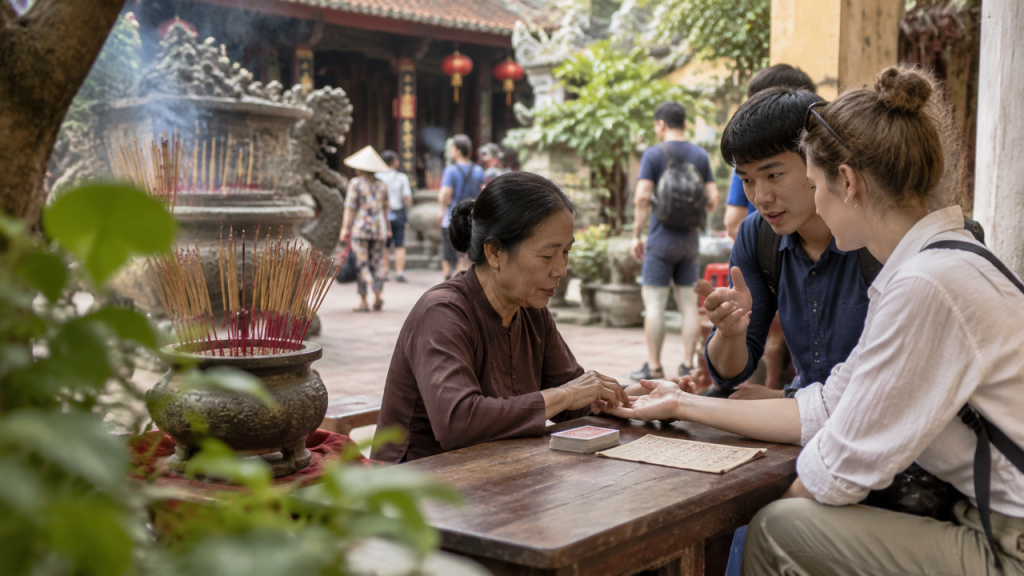
Fortune telling in Vietnam can catch your eye when a reader studies a palm near a busy market or a family pauses at a temple ritual. For curious travelers, Vietnamese divination offers a glimpse of how people seek reassurance, reflect on choices, and make sense of uncertainty. Knowing a little about the custom helps you observe with interest rather than mistake a meaningful tradition for a staged tourist show.
This guide introduces the cultural context behind common readings, including palms, cards, poetry, and astrology, then shares simple ways to approach a session respectfully. If you want to explore local beliefs with context, a guided beliefs and culture tour can help you understand what you see. Treat any prediction as a conversation or prompt for reflection, not a guaranteed outcome or substitute for practical decisions.
Fortune Telling in Vietnam: Cultural Roots and Everyday Meaning
Fortune telling in Vietnam is not one fixed tradition. It is a varied set of practices shaped by family customs, local beliefs, and personal curiosity. For some, a reading offers a moment to think through an uncertain choice; for others, it is simply part of a seasonal or family gathering.
Ideas about fate and harmony often sit alongside practical decisions. Lunar dates, yin-yang concepts, and the I Ching reflect Chinese-influenced traditions, but people interpret them differently across regions and generations. A local encounter can reveal this everyday culture, especially when approached with curiosity rather than assumptions.
What Vietnamese Divination Means
Divination means interpreting signs or systems to reflect on possible outcomes, choices, or timing. A personal reading is not the same as religious worship or honoring ancestors, though these practices may share a cultural setting.
In brief: Vietnamese divination is a flexible way some people seek perspective on decisions or auspicious timing. It may draw on calendars, signs, or other methods, but it does not define one universal belief. A reading is personal guidance or reflection, distinct from worship and ancestor veneration.
When People May Seek a Reading
Someone may consult a reader before marriage, a business decision, or a move, or around Lunar New Year when the coming year is on their mind. The reason may be belief, family custom, or simple curiosity; not everyone takes predictions literally.
| Occasion | What may matter | Possible reason | Keep in mind |
|---|---|---|---|
| Marriage or moving | Auspicious timing | Family custom | Views differ |
| Business or New Year | Luck and direction | Curiosity or belief | Not a guarantee |
If you encounter a reading during a local visit, ask permission before photographing people and treat the exchange respectfully. Vietnam Crazy Tour offers ways to explore local beliefs and customs with context, not as a staged spectacle. Choose an experience that explains the place and its people, then let your own questions guide the conversation.
How Fortune Telling in Vietnam Typically Works
Fortune telling in Vietnam usually begins with choosing a practitioner and deciding what you want to ask. You may share a birth date or another personal detail, then listen as the reader interprets charts, cards, palm lines, or symbols. The format depends on the person, method, and local custom, so no single routine is universal.
What to Expect During a Reading
A first visit can be simple and conversational. For example, a traveler curious about work or relationships might explain the question, provide a birth date if requested, and hear how the practitioner connects those details to a reading.
- Choose a practitioner and agree on the session or price before it begins.
- Share a question and only the personal details you feel comfortable giving.
- Listen, ask how an interpretation was reached, and treat it as cultural insight rather than a guaranteed prediction.
Some readers talk through their impressions; others consult charts, cards, or symbolic systems. If you are exploring local spiritual customs, a ghost and belief culture tour can offer broader context around how traditions appear in everyday life.
How Readings Interpret Signs and Information
Birth-chart readings may use dates and times, while card draws, palm readings, and I Ching-based readings focus on different signs. Practitioners may use these details as prompts for reflection, not objective proof of what will happen.
| Method | What may be used | Useful to know |
|---|---|---|
| Birth chart | Birth date or time | Often structured |
| Cards or palm | Drawn cards or palm lines | Often conversational |
Approach the experience with curiosity and sensible boundaries. The value is often in hearing a local perspective, not handing over decisions about health, money, or travel. For respectful cultural exploration, browse Vietnam Crazy Tour experiences.
Common Reasons People Explore Fortune Telling in Vietnam
Fortune telling in Vietnam often enters the conversation when someone is weighing a personal choice, hoping for reassurance, or curious about a local custom. Visitors may encounter it around a temple, in a neighborhood shop, or through a family recommendation. Understanding why people seek a reading helps you take part respectfully without treating a prediction as a reliable forecast.
People may ask about relationship compatibility, career or business decisions, family concerns, or auspicious dates for a wedding, opening, or journey. Others join simply to experience a familiar part of local life. A reading can offer a moment to pause, but important financial, medical, and legal decisions should rely on qualified advice and evidence.
Life Questions, Relationships, and Auspicious Timing
A couple might ask whether their birth years are considered compatible, while a shop owner may check a date before opening a new business. These customs vary by family and practitioner, so there is no single answer that represents everyone in Vietnam. If you are curious about beliefs in a cultural setting, explore local spiritual traditions with an open mind and ask before taking photos.
Quick answer: People explore fortune telling in Vietnam for reassurance, reflection, relationship or career questions, family matters, and auspicious timing. Some take a reading seriously as cultural guidance; others treat it as an experience. It can prompt useful reflection, but predictions are uncertain and should not replace personal judgment or evidence-based advice.
Personal Reflection Versus Prediction
A reading may help someone name a worry, consider priorities, or talk through options with family. Its value can lie in the conversation rather than in predicting what will happen. For travelers, the best approach is curiosity without pressure: you can listen, ask how the practice works, and decide whether to participate.
| Reason | What someone may seek | A balanced view |
|---|---|---|
| Auspicious timing | A meaningful date for an event | A cultural preference, not a guarantee |
| Personal choices | Reassurance while weighing options | Keep practical evidence in view |
Whether you are traveling solo, as a couple, or with family, treat a reading as an invitation to reflect, not a fixed verdict. For a guided way to discover local stories and customs, browse Vietnam Crazy Tour experiences and choose an outing that fits your comfort level.
How to Choose a Fortune-Telling Experience in Vietnam
Fortune telling in Vietnam can be a lively cultural encounter, but choosing a style that suits your curiosity and comfort matters more than finding a supposedly perfect prediction. Ask what will happen during the session, how long it takes, and what it costs before you begin.
For a first visit, choose a reading that feels interesting rather than intimidating. Treat the conversation as a chance to learn how people interpret uncertainty, not as a substitute for practical advice or a guaranteed forecast.
Quick guide: Tử Vi uses birth details to interpret a person’s chart; card readings use a spread of drawn cards; palmistry interprets lines and features of the hand; and the I Ching uses symbols and changing lines to explore a question. Methods and terminology vary between practitioners, so ask how a particular reading works.
Compare the experience
| Style | What it involves | May suit you if | Ask beforehand |
|---|---|---|---|
| Tử Vi | Birth details and chart interpretation | You enjoy a structured reading | Which details are needed |
| Cards | Drawn cards linked to a question | You prefer a conversational format | How many cards are included |
| Palmistry | Lines and features of the hand | You want a simple, hands-on encounter | Whether touch is involved |
| I Ching | Symbols interpreted around a question | You like reflective, symbolic ideas | How the symbols are selected |
Choose a practitioner with clear boundaries
Before agreeing, confirm the price, session length, language, and whether follow-up questions cost extra. A respectful practitioner should accept it if you decline to share personal details or stop the session. For example, a solo traveler curious about local beliefs can ask for a short explanation-based reading rather than discussing sensitive topics.
If you want to explore spiritual customs in context, a ghost culture experience can add local perspective. Keep any reading personal and low-stakes: use it for reflection, not medical, financial, or relationship decisions. Ready to discover more local culture with a guide? Explore Vietnam Crazy Tour options and choose an experience that fits your pace.
Respectful Visiting Tips, Common Questions, and Next Steps
Fortune telling in Vietnam is a personal cultural practice, not a belief shared by everyone. If you choose a reading, ask permission before taking photos, agree on the price first, and treat predictions as reflection rather than fact. A temple visit is a separate religious or cultural experience, not automatically a fortune-telling session.
Common Mistakes and Respectful Reading Etiquette
Approach a reading with curiosity, not assumptions. Some people enjoy these traditions; others do not. Never photograph a practitioner, client, altar, or ritual without asking. Before starting, confirm the fee and set a spending limit. Leave if someone uses fear, promises guaranteed results, or pressures you to pay for extra services.
For example, if a reading raises an unsettling prediction, you can thank the practitioner and end the session. You are not obliged to buy a remedy or follow advice. Visitors curious about local beliefs can explore them with a guide through Vietnamese ghost culture.
FAQs About Fortune Telling in Vietnam
Is fortune telling widely practiced? It is visible in some communities and life moments, but beliefs and participation vary widely.
What is tử vi, and how is it different from palmistry? Tử vi is astrology based on birth details; palmistry interprets lines and features of the hand.
Do I need to speak Vietnamese? Not always. Ask whether interpretation is available, and clarify the price and language before agreeing.
Should I treat a prediction as fact? No. Regard it as a cultural encounter or personal reflection, not a certain forecast.
Is fortune telling the same as visiting a temple? No. Temples are places of worship and community; some visitors seek readings elsewhere or during particular occasions.
| Experience | What it considers | Visitor note | Best approach |
|---|---|---|---|
| Tử vi | Birth details | May require date and time | Ask what information is needed |
| Palmistry | Hand lines and features | Usually an informal session | Consent before any contact |
Explore Vietnamese Traditions with an Open Mind
Come with questions, respect personal boundaries, and keep your own judgment. For more grounded ways to experience local culture, browse Vietnam cultural tours and choose an experience that fits your interests. A thoughtful visit leaves room for both wonder and difference.